The Star Maker - The Stellar Forge (PT.1)
Published 2025-12-02 09:13:55.0155277 +0000 under 'games'.
Before I start this post, a few notes: 1. because of the sheer complexity of the Stellar Forge, this will be split into two or three posts, 2. I've tried to write this in non-geek speak, but am more than happy to explain stuff if people want & 3. I will probably get something wrong! Feel free to correct me below :) With that done, lets get going.
#1: Where does it all go?
Before we can start on individual systems, we need to take a look at how said systems are placed within the galaxy. The Milky Way is a spiral galaxy, meaning it has a thick middle, and thinner edges. Each spiral outward ("arm") hosts a denser area of stars than the surrounding area.
So how does this link to the Stellar Forge? Well, what it has done is take the density of each part of the Milky Way, and divides it up into sectors of LY3 (think of sectors as cubes of space) Each sector has a sub sector, a sub-sub sector & so on, resulting in 8 layers of sub-sectors. Each sector is allocated some mass, based on its location & how much mass it's parent sector had.
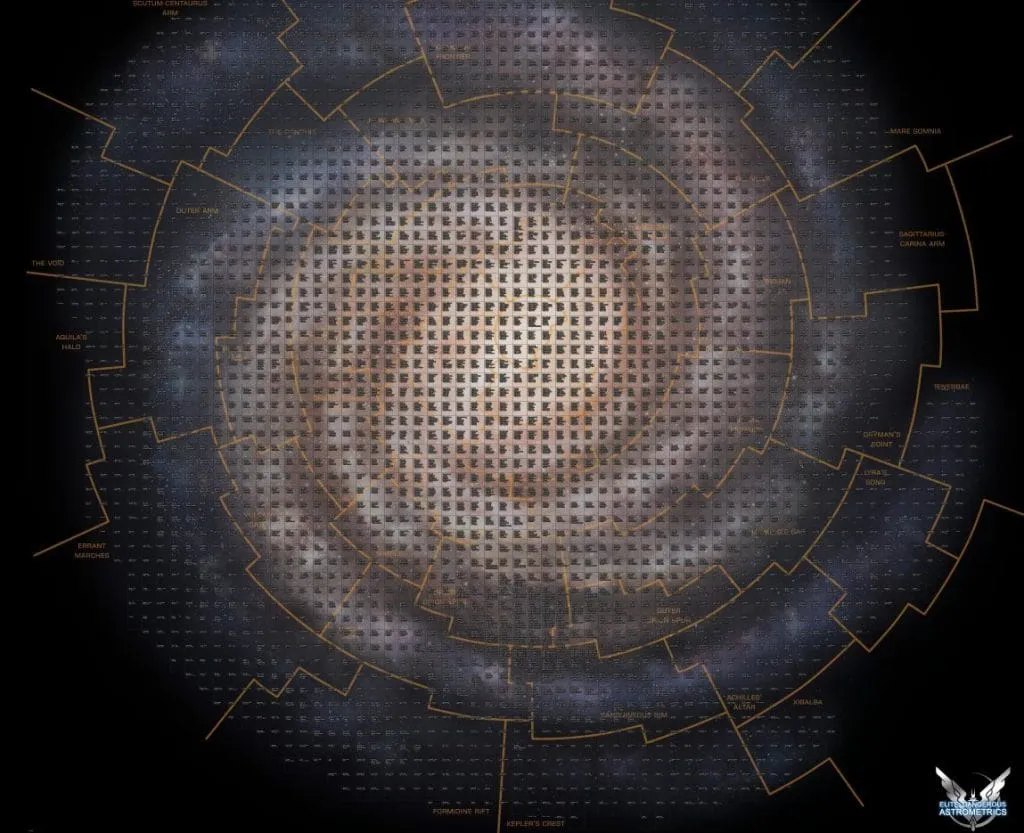
Each 'Sector' is a 1280 LY cube. It uses these cubes to distribute mass (STUFF) everywhere. Image from edastro.com/galmap
#2: Nebulae
Planetary Nebulae (in real life) are formed when a star goes supernova. As the entire thing explodes , dust and gas is thrown outwards. Its this dust and gas that makes up the nebulae.
Unfortunately we can't run the Stellar Forge for millions of years, checking if anything explodes. Instead, what it does is checks for any really heavy stars, and assumes they will go supernova.
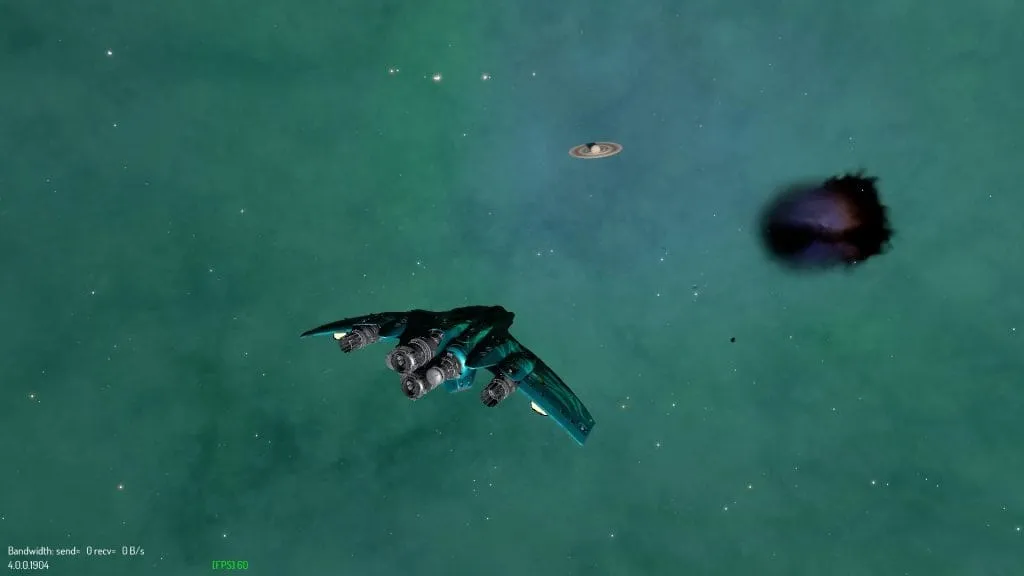
The spirograph planetary nebula, find it on the GEC
So, we have a Nebula now. How will it look? Well there are a few things that dictate that:
-
The temperature of the gas
-
The colour of stars nearby
-
The distance of the stars nearby.
Light from nearby stars is then simulated & run through the gas clouds. Any colours that the gas absorbs is removed, and you're left with a nebula!
Or rather, you're left with lots of colours.
The colour map is then laid over the top of a 3D texture that represents the gas of the nebula. Interestingly enough, this is fairly similar to how the dust in the galaxy map is rendered too.
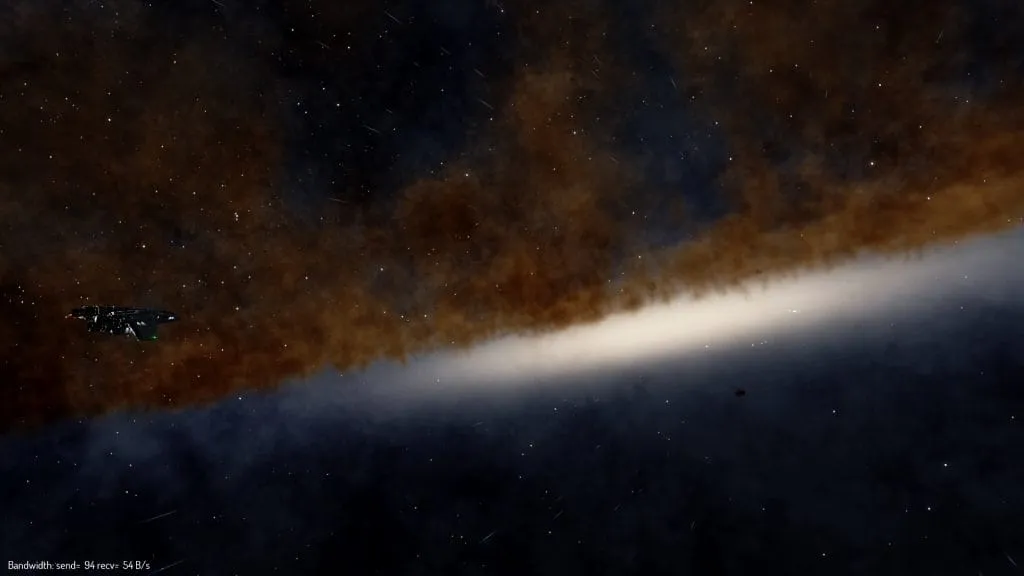
The brown bits are space dust! I'm just below the galactic plane here.
With the dust though, the 3D texture is calculated by using up all the left-over mass from the sub-sectors from earlier.
#3: To Conclude
That was part one! Can you see why I have split it up into a few posts now? 😅 In the next instalment, I will be looking at the creation of planets. Hope you enjoyed!
Sources: Discovery Scanner, Stellar Forge (E:D Wiki)